
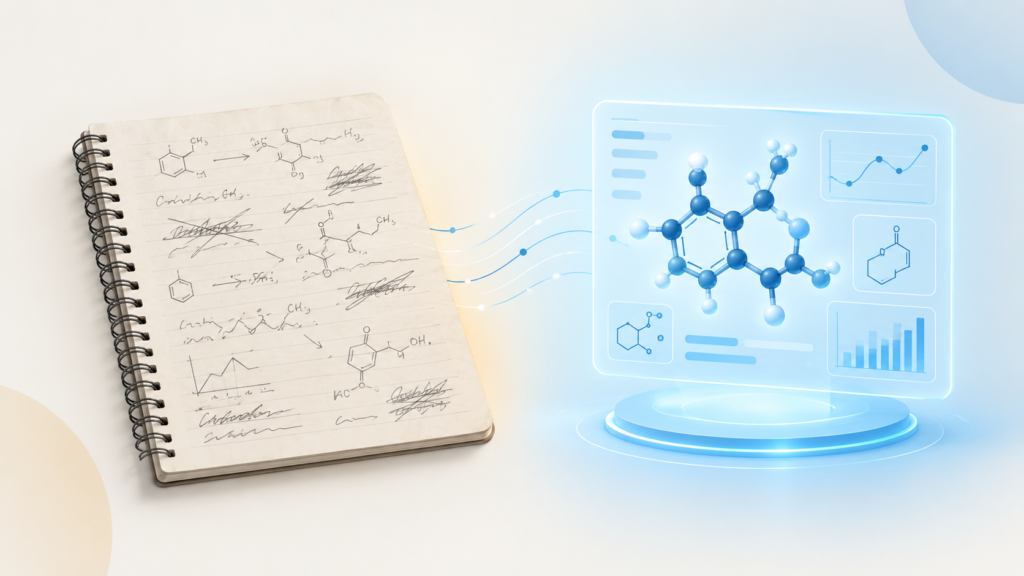
The tools cosmetic chemists relied on for decades are giving way to something faster, smarter, and globally compliant from day one.
For most of the twentieth century, a cosmetic chemist’s most important tool was a spiral-bound notebook — dense with handwritten ratios, crossed-out revisions, and margin notes from failed stability tests. That notebook was irreplaceable. It was also slow, siloed, and impossible to scale.
In the past two years, the formulation landscape has shifted faster than most labs expected. AI-driven platforms are compressing R&D cycles that once took months into workflows measured in hours. The question is no longer whether to adopt these tools — it’s how to use them without losing scientific rigor.
The Old Workflow Had a Ceiling
Traditional formulation relies on a chemist’s accumulated knowledge: intuition built over years of trial, and reference tables that don’t update themselves. It works — until you need to reformulate for a new regulatory market, source a substitute ingredient mid-project, or hit a cost target without touching performance.
Each of those pivots, in a manual workflow, means starting largely from scratch: new compatibility checks, new stability runs, new INCI label drafts. Projects that should take weeks stretch into quarters.
This is exactly the gap that AI formulation tools are designed to close — not by replacing the chemist, but by eliminating the administrative weight that keeps them from doing actual science.
How AI Changes the Loop
Ingredient selection and ratio recommendations
Given a target product category, skin type, and regional market, an AI engine can recommend ingredient combinations and starting ratios based on patterns learned from thousands of validated formulas. Instead of blank-page ideation, the chemist begins with a structured candidate — one they can interrogate, challenge, and refine.
Compliance from the first draft
Regulatory compliance has historically been a late-stage gate — a source of expensive surprises close to launch. AI formulation platforms check concentration limits and restricted substance lists for your target markets as you build. A formula intended for the EU, Japan, and North America simultaneously can be validated against all three regulatory frameworks before a single batch is made.
Stability prediction before you bench it
Bench stability testing still has a role, but AI models trained on prior stability data can flag likely failure modes early — saving weeks of incubation time on formulations that would have been reformulated anyway.
A Modern Formulation Workflow
Here is how a formulation project looks when AI is embedded throughout:
Define the brief. Skin type, target market, cost ceiling, performance requirements, and any regulatory constraints go into the AI generator. This takes minutes, not days.
Review the candidate formula. The AI returns a structured starting point — ingredient list, ratios, INCI name draft, and flagged compliance notes. The chemist evaluates it scientifically, not administratively.
Iterate rapidly. Substituting an ingredient, adjusting a ratio, or switching a target market triggers an immediate re-check. What once required a full documentation pass now updates in seconds.
Run targeted bench work. With a pre-validated candidate, bench time is spent confirming and refining, not searching for a starting point. Stability tests are more focused; failure rates drop.
Export complete documentation. INCI-compliant labels, stability reports, and scale-up notes are generated from the live formula, not assembled manually afterward.
The Tools That Support This
FormulaAlchemy was built around this exact workflow. The platform brings together the AI Formula Generator, a Formulation Manager, deformulation tools, label generation, and technical calculators — including an HLB calculator for emulsifier selection and a soap lye calculator — in one connected environment.
The uncertainty calculator is worth a specific mention: it combines Monte Carlo simulation with auto-spreadsheet processing and ISO 17025-compliant reporting, which matters deeply for labs that supply documentation to regulated markets. It’s the kind of tooling that previously required either expensive licensed software or hours of manual spreadsheet work.
What This Means for Cosmetic Scientists
The skills that make a great formulation chemist — deep ingredient knowledge, sensory intuition, understanding of how chemistry behaves at scale — are not made redundant by AI. They become more valuable, because the chemist can now direct them at real problems instead of paperwork.
What does change is the expectation of speed. Clients, buyers, and brand teams used to AI-assisted ideation in other parts of their business are expecting faster cycles from their formulation partners. Labs that build fluency with these tools now will be better positioned to meet that expectation — and to take on more projects without expanding headcount.
The lab notebook isn’t going away entirely. But the days of it being the center of a formulation workflow are numbered.
Start formulating with AI today
Access the AI Formula Generator, compliance tools, technical calculators, and the full formulation platform — free to start.
Explore FormulaAlchemy