
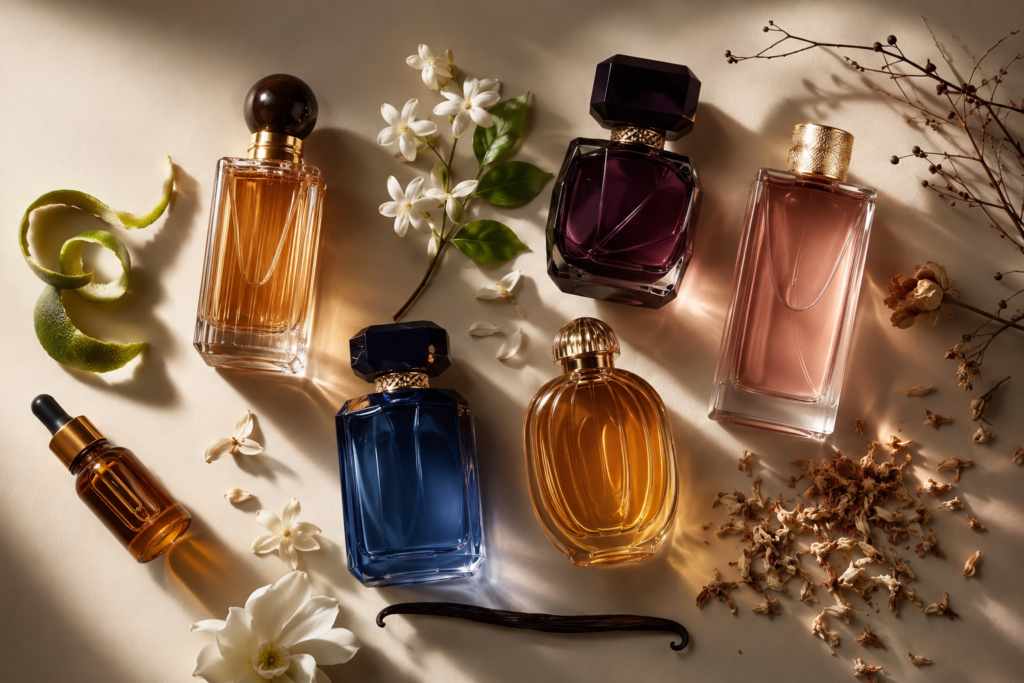
The Perfumer’s Complete Reference
The Art of Fragrance
Famous formula reconstructions, raw ingredient reference, the formulation process, and safety guidance — all in one place.
Formulas are reference reconstructions based on publicly known notes and industry analysis. Exact proprietary ratios remain trade secrets.
The Fragrance Pyramid
Every perfume is built from three layers, each evaporating at a different rate. Together they create the full arc of a scent, from first spray to final dry-down.
| Layer | Share of Concentrate | Timing |
|---|---|---|
| Top Notes | 15–25% | First 15–30 min |
| Heart Notes | 40–55% | 1–4 hours |
| Base Notes | 25–35% | 4–12+ hours |
Top notes are what you smell in the first seconds — bright, volatile, and quick to fade. Heart notes bloom next, forming the emotional core of the fragrance. Base notes are the slowest to develop but the longest to linger, giving a perfume its lasting signature on skin.
Ingredients by Layer
All percentages refer to an ingredient’s share of the concentrate — before it’s diluted into alcohol.
Top Notes
| Ingredient | Typical % | Character |
|---|---|---|
| Bergamot EO | 6–12% | Fresh citrus, slightly floral — the classic opening |
| Lemon EO | 3–8% | Bright, sharp citrus with good sparkle |
| Grapefruit EO | 2–6% | Juicy, slightly bitter — adds freshness |
| Petitgrain EO | 2–5% | Woody green citrus leaves; bridges top to heart |
| Lavender EO | 3–7% | Herbal, soft floral — versatile bridging note |
| Neroli EO | 2–5% | Delicate orange blossom, refined and airy |
Heart Notes
| Ingredient | Typical % | Character |
|---|---|---|
| Rose Absolute | 8–18% | The classic floral — rich, complex, and lasting |
| Jasmine Absolute | 7–15% | Sweet, heady, slightly animalic floral |
| Ylang Ylang EO | 1–5% | Exotic, creamy, narcotic — use with restraint |
| Geranium EO | 4–10% | Rosy, green, excellent balancing ingredient |
| Hedione (synth.) | 3–10% | Transparent jasmine diffusion — lifts the whole blend |
| Iris Absolute | 2–6% | Powdery, violet-like, soft and sophisticated |
Base Notes
| Ingredient | Typical % | Character |
|---|---|---|
| Sandalwood EO | 5–12% | Creamy, smooth, milky wood — the anchor |
| Iso E Super (synth.) | 4–10% | Cedar-like amplifier — adds depth and projection |
| Galaxolide (synth.) | 4–10% | Clean, skin-close musk for longevity |
| Vetiver EO | 2–6% | Smoky, earthy, rooty — grounds the fragrance |
| Benzyl Benzoate | 3–8% | Fixative and blending solvent — mild balsamic |
| Vanilla Absolute | 2–6% | Sweet, warm, gourmand — adds comfort and warmth |
| Amber Resinoid | 3–8% | Warm, powdery resin — oriental depth |
| Labdanum Absolute | 2–5% | Animalic, leathery, resinous — unique warmth |
Example EDP Formula
A complete floral oriental at 20% concentration. All percentages are within the concentrate.
Top notes · 20% — Bergamot EO 10%, Lemon EO 6%, Grapefruit EO 4%
Heart notes · 50% — Rose absolute 15%, Jasmine absolute 12%, Ylang ylang EO 5%, Geranium EO 8%, Hedione 7%, Iris absolute 3%
Base notes · 30% — Sandalwood EO 10%, Iso E Super 8%, Galaxolide 5%, Benzyl benzoate 5%, Vanilla absolute 2%
Concentrate total: 100%
To make 10 ml of finished EDP: Perfumer’s alcohol 7.8 ml (78%), Concentrate 2.0 ml (20%), Distilled water 0.2 ml (2%)
Always add concentrate to alcohol, never the reverse. Macerate sealed for 2–6 weeks before evaluating the final scent.
Concentration Types
The same concentrate, diluted differently, produces a completely different wearing experience.
| Type | Oil % | Alcohol % | Water % | Longevity |
|---|---|---|---|---|
| Parfum (Extrait) | 20–40% | 60–80% | 0% | 8–12 hrs |
| Eau de Parfum | 15–20% | 75–82% | 0–5% | 6–8 hrs |
| Eau de Toilette | 8–15% | 80–88% | 0–5% | 4–6 hrs |
| Eau de Cologne | 2–5% | 70–80% | 15–25% | 2–3 hrs |
| Body mist | 0.5–2% | 50–70% | 28–50% | <1 hr |
| Perfume oil | 10–30% | 0% | 0% | 6–10 hrs |
The Formulation Process
Follow this sequence every time — shortcuts in the early stages cause problems that are hard to reverse.
- Define the concept. Choose a scent family — floral, woody, oriental, fresh, chypre, or fougère. Write a brief: mood, target audience, season, reference fragrances. This anchors every ingredient decision that follows.
- Set up and weigh precisely. Use a precision scale (0.01g resolution). Work in glass vials. Always measure by weight, not volume — density varies. Label everything immediately with the date and formula version. Start with 1–5g batches to conserve expensive materials.
- Build the base accord first. Blend all base note ingredients together. Allow 30 minutes before evaluating — base notes are slow to open. They should smell rich and rounded, not harsh or flat. Adjust ratios and rest again.
- Build and add the heart accord. Blend heart notes separately, then combine with the base accord. Smell on a strip at 0, 15, and 30 minutes. The heart should bloom and develop — not sit flat or disappear immediately.
- Add top notes last. Top notes evaporate quickly — adding them last prevents over-testing. After adding, smell on skin (not just strips). Skin chemistry transforms the accord; what smells sharp on paper may be beautiful on skin.
- Dilute into alcohol. Pour concentrate into alcohol — never the reverse. For a 10ml EDP at 20%: 2.0ml concentrate + 7.8ml perfumer’s alcohol + 0.2ml distilled water. Use a calibrated pipette or syringe. SD40-B (perfumer’s alcohol) is the standard; DPG for oil-based.
- Macerate — the resting period. Seal the vial and store in a cool, dark place for 2–6 weeks. Molecular bonds settle, off-notes smooth out, and the full accord emerges. Smell weekly and log your observations. Most beginners skip this — and regret it. Week 3 smells nothing like day 1.
- Evaluate the dry-down. Apply to the inner wrist. Smell at 5 minutes (top), 30 minutes (heart developing), 2 hours (full heart), and 6 hours (base longevity). Assess: opening, bloom, dry-down, sillage, longevity.
- Adjust and iterate. If the opening is weak, increase top notes or add a fresher citrus. If it fades too quickly, add more fixative (benzyl benzoate, musks). If the base is too heavy, reduce sandalwood or amber. Document every change.
- Stability testing. Place samples in three conditions: room temperature, refrigerated, and in indirect light. Check at 2 and 4 weeks for color shift, hazing, or scent change. Citrus top notes oxidize fastest — use amber glass. A formula that isn’t stable isn’t ready to bottle.
Safety & IFRA Compliance
The International Fragrance Association (IFRA) sets maximum usage levels for skin safety. Check every ingredient before finalizing a formula.
- High-risk ingredients: Cinnamon bark, oakmoss, citral, cinnamaldehyde, and coumarin have very low IFRA limits for leave-on products.
- Citrus caution: Expressed citrus oils (bergamot, lime, lemon) can be phototoxic. Use bergapten-free (FCF) versions for leave-on use.
- Leave-on vs. rinse-off: Fine fragrance limits differ from body lotion or rinse-off limits. Always check the correct category for your application.
- Skin sensitizers: Isoeugenol, hydroxycitronellal, and many musks are known sensitizers. Log all sensitizers in your formula record.
- pH range: Finished fragrance should sit between pH 5–7. Test with strips; adjust with citric acid (lower) or TEA (raise).
- Documentation: Keep a complete SDS (Safety Data Sheet) file for every ingredient. Required for commercial production in most markets.
Four Legendary Formulas
The ingredient breakdowns behind some of the world’s most iconic fragrances — from a 1921 floral aldehyde to a 2015 woody fougère.
1921 · Floral Aldehyde · EDP
Chanel No. 5
Created by Ernest Beaux for Coco Chanel. The first perfume to use synthetic aldehydes at a transformative level — turning a floral bouquet into something abstract, modern, and unforgettable. Rose and jasmine wrapped in a sheer aldehydic veil; Marilyn Monroe’s bedside companion.
Top (~19%): Aldehydes C10/C11/C12 (9%), Bergamot (5%), Lemon (3%), Neroli (2%)
Heart (~45%): May Rose absolute (18%), Jasmine absolute (15%), Ylang ylang (5%), Iris absolute (4%), Lily of the valley (3%)
Base (~36%): Benzyl acetate (15%), Benzyl salicylate (10%), Musk ketone (5%), Sandalwood (3%), Vetiver & Patchouli (2%), Vanillin + Coumarin (1%)
Dilution: 78% alcohol / 20% concentrate / 2% water
Signature molecule
Aldehydes C10 / C11 / C12
The revolutionary touch. Synthetic aldehydes give No.5 its soapy-clean shimmer, lifting the rose/jasmine heart into something abstract and modern. Beaux overdosed them at levels never before seen in 1921.
“I presented several samples to Mademoiselle Chanel. She chose the fifth. I told her: the name of this perfume will be No.5.” — The aldehydes, accidentally overdosed during lab preparation, became the accidental genius of the century.
1925 · Oriental · Parfum
Guerlain Shalimar
Inspired by the Shalimar Gardens of Lahore and the love of Emperor Shah Jahan for Mumtaz Mahal. Legend holds it was born when Guerlain poured a bottle of ethylvanillin into a flask of Jicky — and the first true oriental fragrance was born. A shocking 30% bergamot gives it a bright opening into the famous Guerlinade base.
Top (~37%): Calabrian bergamot (30%), Lemon (5%), Mandarin (2%)
Heart (~36%): Jasmine absolute (12%), Rose absolute (10%), Orris/Iris absolute (7%), Patchouli (4%), Vetiver Bourbon (3%)
Base (~33%): Ethylvanillin (12%), Tonka bean absolute (7%), Opoponax resinoid (5%), Sandalwood Mysore (4%), Frankincense (3%), Musks + Civet (2%)
Dilution: 73% alcohol / 25% concentrate / 2% water
Signature molecule
Ethylvanillin
Three times sweeter than vanillin — a then-new synthetic molecule Guerlain overdosed into the Jicky accord. Its carnal, balsamic sweetness defined the entire oriental fragrance family.
Reportedly discovered by accident when Guerlain poured an overdose of the new synthetic ethylvanillin into a flask of Jicky and found the result so intoxicating he spent days refining it. Shalimar premiered at the 1925 Paris Exhibition of Decorative Arts.
1977 · Oriental Spicy · EDP
YSL Opium
A holy trinity of cinnamon, benzoin, and vanilla that scandalized and seduced in equal measure — the most opulent, spice-heavy oriental of its era.
Top (~24%): Mandarin/Tangerine (10%), Bergamot (7%), Plum + Black currant (4%), Pepper (3%)
Heart (~37%): Rose absolute (12%), Cinnamon bark (8%), Carnation/Eugenol (7%), Jasmine absolute (6%), Clove bud (4%)
Base (~37%): Benzoin resinoid (12%), Sandalwood (8%), Vanilla absolute (7%), Labdanum/Amber (5%), Vetiver + Patchouli (3%), Musks + Civet (2%)
Dilution: 80% alcohol / 18% concentrate / 2% water
Signature accord
Cinnamon + Benzoin + Vanilla
Cinnamon drives the spicy heat, benzoin provides the incense-resin body, and vanilla rounds it into a gourmand warmth that lasts over twelve hours on skin.
The launch party on the tall ship Peking in New York harbor drew 800 guests, protesters, and front-page headlines. YSL called it “the most scandalous perfume ever made.” The formula was designed to provoke — and has never apologized for it.
2015 · Aromatic Fougère · EDT
Dior Sauvage EDT
The world’s best-selling men’s fragrance, built around custom Calabrian bergamot and a massive dose of ambroxan — a synthetic amber molecule derived from ambergris that clings to skin for hours.
Top (~37%): Calabrian bergamot (25%), Black pepper (5%), Sichuan pepper (4%), Pink pepper (3%)
Heart (~25%): Lavender French (12%), Geranium Bourbon (6%), Elemi resinoid (4%), Vetiver (3%)
Base (~38%): Ambroxan (20%), Cedar Virginia (8%), Labdanum absolute (5%), Patchouli (3%), Ethyl maltol (2%)
Signature molecule
Ambroxan (~20%)
The skin-clinging, woody-amber molecule that gives Sauvage its unmistakable modern trail and made it the most polarizing (and best-selling) men’s fragrance of the 2010s.
Six More Icons Across a Century
1999 · Floral · EDP
Dior J’adore
Created by Calice Becker. A luminous “golden floral” bouquet anchored by ylang-ylang, rose, and jasmine — worn by Charlize Theron in Dior’s iconic campaigns. EDP 18%, top notes of pear/melon/bergamot/mandarin, a rich floral heart, and a sandalwood-vanilla-musk base.
Signature accord
Ylang Ylang + Rose + Jasmine
Produces J’adore’s unmistakable warm radiance.
“Becker was asked to create ‘a great floral’ that didn’t rely on aldehydic tricks. The result became Dior’s best-selling fragrance within a year — and has never left the top ten since.”
2012 · Floral Gourmand · EDP
Lancôme La Vie Est Belle
Created by Polge, Ropion & Flipo. The iris-and-praline accord that defined a decade of feminine fragrance. EDP 20%, fronted by Julia Roberts.
Signature accord
Iris + Praline + Patchouli
Iris for powdery sophistication, praline for addictive sweetness, patchouli to ground it.
“The brief was ‘happiness’ — the result outsold every other Lancôme fragrance within its first year.”
2001 · Fresh Oriental · EDP
Chanel Coco Mademoiselle
Created by Jacques Polge. The modern counterpart to the original Coco — sparkling bergamot and orange opening into a rose-jasmine heart and deep patchouli-vetiver base. EDP 20%. Consistently a top-five global bestseller.
Signature accord
Bergamot + Patchouli + Rose
“Coco Mademoiselle became one of the most imitated perfumes in history, launching an entire genre of bergamot-patchouli fragrances.”
2007 · Fresh Floral · EDT
Marc Jacobs Daisy
Created by Alberto Morillas. A fresh, youthful floral balancing clean violet leaf with sweet strawberry, anchored by sandalwood and vanilla. EDT 12%. The daisy-topped bottle became as famous as the scent inside.
Signature accord
Violet Leaf + Gardenia + Sandalwood
“Morillas designed Daisy as an antidote to the heavy, celebrity-driven fragrances of the era — deliberately light, joyful, and approachable.”
2012 · Aromatic Fougère · EDT
Versace Eros
Created by Olivier Cresp. A powerhouse men’s fragrance opening with mint and green apple over vanilla and tonka bean. EDT 14%. “Beast mode in a bottle.”
Signature accord
Mint + Tonka + Ambroxan
Cold, electrifying opening, warm coumarin-rich body, and a skin-amplifying woody-amber trail.
“Cresp, the perfumer behind Angel (Thierry Mugler), applied the same maximum-impact philosophy to Eros. Within two years it had inspired dozens of imitators and become a barbershop staple worldwide.”
2010 · Fruity Chypre · EDP
Creed Aventus
Created by Olivier & Erwin Creed. Inspired by Napoleon Bonaparte’s ambition, power, and exile. The pineapple-birch-musk accord that defined an entire genre of “pineapple fougères.” EDP 22%. The world’s most-reviewed men’s fragrance.
Signature accord
Pineapple + Birch + Musk
“Aventus became the most discussed fragrance on the internet, with dedicated online communities tracking batch variations. No niche fragrance has come close to matching its cultural impact.”
Side-by-Side Comparison
| Perfume | Year | Family | Signature | Strongest Tier | Longevity | Conc. |
|---|---|---|---|---|---|---|
| Chanel No.5 | 1921 | Floral Aldehyde | Aldehydes (~9%) | Heart | 6–8 hrs | EDP 20% |
| Guerlain Shalimar | 1925 | Oriental Amber | Ethylvanillin (~12%) | Top | 8–12 hrs | Extrait 25% |
| YSL Opium | 1977 | Oriental Spicy | Cinnamon + Benzoin | Base | 10–12+ hrs | EDP 18% |
| Dior J’adore | 1999 | Floral | Ylang + Rose + Jasmine | Heart | 7–9 hrs | EDP 18% |
| Coco Mademoiselle | 2001 | Fresh Oriental | Patchouli + Bergamot | Base | 8–10 hrs | EDP 20% |
| Marc Jacobs Daisy | 2007 | Fresh Floral | Violet Leaf + Gardenia | Heart | 5–7 hrs | EDT 12% |
| Creed Aventus | 2010 | Fruity Chypre | Pineapple + Birch | Top | 10–12+ hrs | EDP 22% |
| Versace Eros | 2012 | Aromatic Fougère | Mint + Ambroxan | Heart | 8–10+ hrs | EDT 14% |
| La Vie Est Belle | 2012 | Floral Gourmand | Iris + Praline | Base | 8–10+ hrs | EDP 20% |
| Dior Sauvage | 2015 | Aromatic Fougère | Ambroxan (~20%) | Top | 7–9 hrs | EDT 12% |
Reference reconstructions only. Actual proprietary formulas are trade secrets owned by their respective houses.
Ingredient percentages are based on publicly available note analysis, academic fragrance literature, and GCMS reconstruction data.
For educational and reference purposes. Always verify IFRA compliance before skin application.
