
Summer SPF Formulation: Common Mistakes That Tank Your Sun Protection Factor
You did the math. Your UV filter percentages add up to a theoretical SPF of 50. Then it comes back from the lab at 28.
If you’ve formulated sunscreens, you know this gap is one of the most frustrating problems in the category — and one of the most common reasons products fail testing, blow through development budgets, or underperform once they hit shelves. The good news: most SPF shortfalls trace back to a handful of predictable mistakes. Here’s what actually tanks your SPF, and how to fix it before it costs you a round of stability and efficacy testing.
Mistake #1: Treating SPF as Purely Additive
It’s tempting to think of SPF like a simple sum — 5% Filter A gives you X, 5% Filter B gives you Y, so together you get X+Y. In reality, UV filters interact. Some combinations synergize and boost protection beyond what you’d predict; others compete for the same UV wavelengths and actually suppress each other’s efficacy.
Fix: Use published absorption spectra for each filter and check for overlap in the UVB (280–320nm) and UVA (320–400nm) ranges before finalizing a blend. Filters with overlapping peak absorption don’t stack cleanly — you’re often paying for redundancy, not protection.
UVB (280–320nm)
UVA (320–400nm)
280nm
400nm
Absorption
Filter A (UVB-focused) Filter B (overlaps A — redundant) Filter C (fills UVA gap)
Illustrative example: Filter B’s peak overlaps heavily with Filter A, adding cost without meaningfully extending coverage. Filter C, which peaks in the underserved UVA range, contributes more to actual broad-spectrum protection.
Mistake #2: Ignoring Filter Photostability
Some organic UV filters degrade under UV exposure. Avobenzone is the classic example — without a stabilizing partner, it can lose a significant portion of its efficacy within the first hour of sun exposure. If your formula tests well in a lab spectrophotometer reading but underperforms in real-world or in-vivo testing, photodegradation during exposure is a prime suspect.
Fix: Pair photo-unstable filters with known stabilizers (octocrylene is the most common avobenzone stabilizer) and always validate photostability, not just initial absorbance, before locking a formula.
Mistake #3: Poor Film Formation on Skin
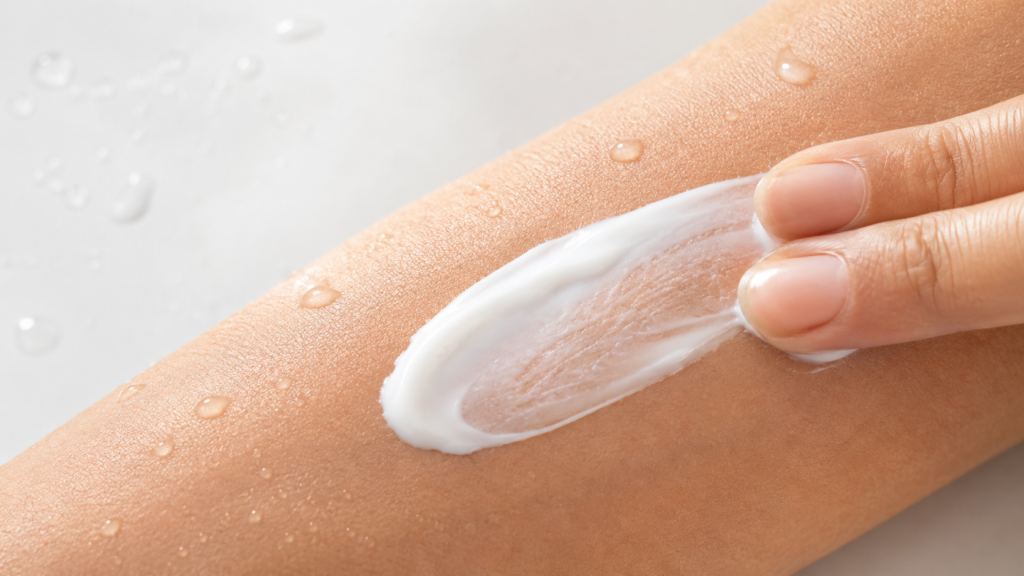
SPF is measured based on an even, continuous film of product at a standardized application rate (2 mg/cm²). If your formula doesn’t spread evenly, beads up, or gets absorbed too quickly into skin before it can form a uniform layer, you get uneven UV filter distribution — and uneven distribution disproportionately lowers SPF, even if the average filter concentration is correct.
This is a formulation and sensory issue as much as an active-ingredient issue. Emollient selection, viscosity, and the emulsion system all affect film formation.
Fix: Evaluate spreadability and film uniformity early, not just after the active package is finalized. A cosmetically elegant base isn’t a “nice to have” here — it’s directly tied to efficacy.
Mistake #4: Underestimating Real-World Application Rates
Consumers rarely apply sunscreen at the 2 mg/cm² rate used in official SPF testing. Real-world application is frequently closer to half that amount — which means real-world protection can be significantly lower than the SPF number on the label suggests.
You can’t formulate your way around consumer under-application, but you can design for it.
Fix: Consider building in a protection margin above your label target, and make application-amount education part of your product’s marketing and packaging (e.g., pump dosing, application guides).
Mistake #5: Emulsion Instability Masking as an SPF Problem
Sometimes a “low SPF result” isn’t a UV filter problem at all — it’s an emulsion problem. If your emulsifier system isn’t holding the UV filters in stable, even dispersion (particularly with mineral filters like zinc oxide or titanium dioxide, which need to stay properly dispersed rather than settling or aggregating), you’ll get inconsistent filter distribution across the applied film, and inconsistent results across test replicates.
Fix: Confirm emulsion and dispersion stability independently before troubleshooting the UV filter blend itself. Check your HLB targeting for the emulsifier system — mismatched HLB is a frequent hidden cause of poor filter dispersion.
Bringing It Together
Most SPF shortfalls aren’t a single dramatic error — they’re the compounding effect of two or three of these issues stacking on top of each other. A slightly unstable filter blend, applied through a mediocre film-former, in an emulsion that’s borderline stable, can turn a theoretical SPF 50 into a tested SPF in the high 20s without any single “smoking gun.”
Before you send a formula for expensive in-vivo SPF testing, it’s worth running through this list systematically:
- Check filter combinations for spectral overlap
- Confirm photostability, not just initial absorbance
- Evaluate film formation and spreadability
- Build in a margin for real-world under-application
- Validate emulsion/dispersion stability independently
Get these right in the lab, and you’ll spend a lot less time — and budget — chasing SPF numbers after the fact.
Want to check your UV filter blend or emulsifier system before your next test round? Try our free SPF Calculator and HLB Calculator to model your formula’s estimated performance before you send it to the lab.
