
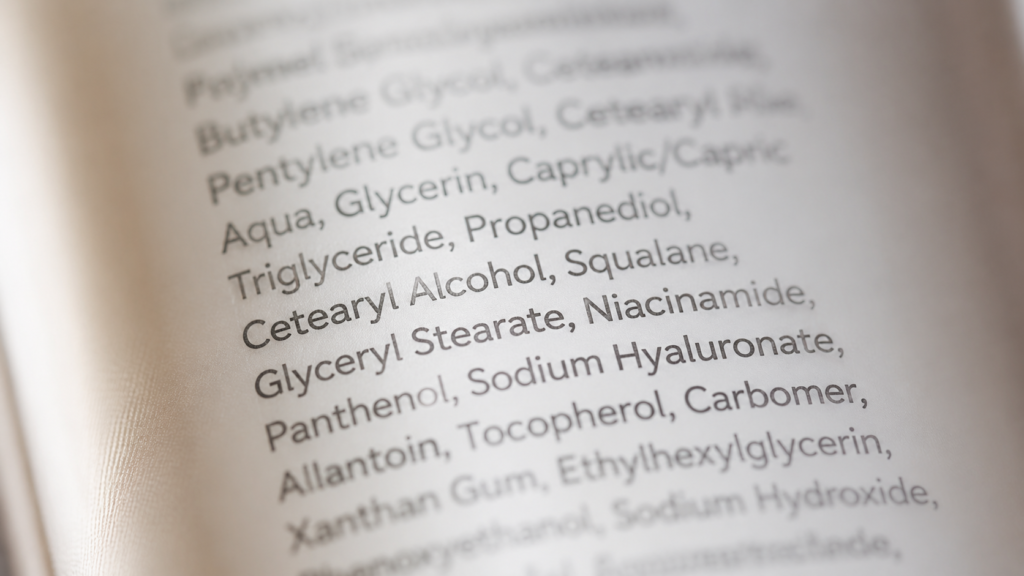
Reading an INCI List Like a Chemist: A Beginner’s Guide to Ingredient Decoding
Flip over almost any cosmetic product and you’ll find a wall of unfamiliar Latin and chemical names. To most people it’s noise. To a formulator, it’s a complete technical brief — you can tell what a product is trying to do, roughly how it’s built, and where potential problems might hide, all from that one list.
Here’s how to actually read it.
What INCI Actually Is
INCI stands for International Nomenclature of Cosmetic Ingredients — a standardized naming system so that a given ingredient has the same name on a label whether the product is sold in the US, EU, or elsewhere. Plant-derived ingredients typically use Latin botanical names (Helianthus Annuus Seed Oil is sunflower seed oil), while synthetic or processed ingredients use standardized chemical or trade names (Sodium Hyaluronate, Dimethicone).
It’s not marketing copy — it’s a regulatory requirement, and that’s exactly what makes it useful to read closely.
Rule #1: Order Means Concentration
In most regulatory frameworks, ingredients above 1% concentration must be listed in descending order by concentration. This is the single most useful decoding rule: the first five or six ingredients tell you what the product is actually made of.
Example:Aqua, Glycerin, Cetearyl Alcohol, Caprylic/Capric Triglyceride, Dimethicone, Niacinamide...
This is a water-based emulsion (water first), humectant-forward (glycerin second), with a fatty alcohol and emollient system providing texture, before you even reach the “hero” active — niacinamide, likely present at a meaningful but moderate concentration.
Below 1% concentration, ingredients can be listed in any order — which is why preservatives, fragrance, and many actives cluster near the end of a list regardless of how functionally important they are.
Annotated Example
Aqua, Glycerin, Cetearyl Alcohol, Caprylic/Capric Triglyceride, Dimethicone, Niacinamide, Xanthan Gum, Phenoxyethanol, Parfum…
Base / vehicle (highest concentration)
Texture-building emollients
Active ingredient (position ≠ potency)
Rule #2: Learn to Spot Ingredient Categories by Name Pattern
- Latin binomial names (
Xxx Yyy [Part] [Form]) → plant-derived: oils, extracts, waters - “-yl” and “-ate” endings → often esters, common as emollients (
Cetyl Palmitate,Isopropyl Myristate) - “-icone” / “-iloxane” endings → silicones (
Dimethicone,Cyclopentasiloxane) - “Sodium/Potassium/Ammonium” + surfactant root → cleansing agents (
Sodium Laureth Sulfate) - Numbers in the name → often indicate polymer chain length or ethoxylation (
Steareth-21,PEG-100) - CI + 5-digit number → colorants (Colour Index), not always obvious from the number alone
Rule #3: The First Ingredient Tells You the Product Type
If the first ingredient is Aqua/Water, you’re almost certainly looking at an oil-in-water emulsion or a water-based formula. If an oil or ester leads the list, it’s likely anhydrous (oil-based) or a water-in-oil emulsion. This single data point will tell you more about how a product will actually feel and perform than most marketing claims on the front of the package.
Rule #4: Don’t Assume Position Equals Importance
This is the most common beginner mistake. A hero active listed 14th isn’t necessarily “just a trace amount” — many actives (retinoids, peptides, certain plant extracts) are effective at concentrations well under 1%, meaning their position tells you almost nothing about efficacy. Conversely, an ingredient near the top of the list isn’t automatically “better” — it might just be a texture-building emollient with no functional claim at all.
Position tells you concentration rank, not concentration amount, and definitely not efficacy.
Rule #5: Cross-Check, Don’t Guess
INCI names are precise but not always intuitive, and the same functional ingredient can appear under several different INCI names depending on supplier and form. When you’re unsure what an ingredient is, does, or how it’s regulated in a given market, don’t guess from the name alone — cross-reference it against a proper ingredient database.
Putting It Into Practice
Next time you pick up a product, try this: read the first five ingredients and predict the texture and product type before you touch it. Then check the list for any actives you recognize, and note their position as a rough (not definitive) indicator of concentration. With a bit of practice, a 20-ingredient wall of Latin and chemical names starts to read less like noise and more like a formula sheet.
Want to decode a real ingredient list? Use FormuCheck — search any INCI name, CAS number, or chemical ID to see what it is and its regulatory status across markets.
