
Concept to Shelf: What Actually Happens in Scale-Up (and Where Formulas Break)
A formula that performs beautifully in a 200g lab batch doesn’t always survive the trip to a 2,000-liter production run. Scale-up isn’t just “make more of the same thing” — it’s where a lot of formulas reveal problems that never showed up at bench scale. Here’s what actually happens at each stage of development, and where things most commonly go wrong.
Stage 1: Brief & Discovery
1
This stage is about constraints, not creativity yet. Before any chemistry happens, a clear brief needs to nail down: target market and use case, performance requirements (texture, efficacy, shelf life), regulatory constraints for the intended markets, and cost targets at production volume.
Where it breaks: Skipping cost-at-scale targets here is one of the most common mistakes. A formula optimized purely for lab performance, without cost constraints from day one, often needs a full reformulation once real ingredient pricing at volume is known.
Stage 2: Formula Development
2
Candidate formulas are built and iterated at small (typically 100–500g) batch sizes, where it’s fast and cheap to test multiple ingredient combinations and ratios against the brief’s requirements.
Where it breaks: Small-batch mixing is far gentler and more controlled than production equipment. A formula that emulsifies perfectly with a lab overhead stirrer can behave completely differently under the higher shear, different heat transfer rates, and longer mixing times of production-scale equipment.
Stage 3: Testing & Optimization
3
Candidate formulas go through stability testing (heat/cool cycling, freeze-thaw, accelerated aging), performance evaluation against the brief’s requirements, and refinement based on results.
Where it breaks: This is where formulas most often reveal that “stable at lab scale” and “stable at production scale” are two different claims. A formula that passes accelerated stability testing at small batch size can still separate or degrade differently when the ratio of surface area to volume changes at production scale — cooling rates, oxygen exposure, and mixing dynamics all shift.
Stage 4: Ready-to-Produce (Scale-Up)
4
The formula is translated into a complete production brief: ingredients, approved suppliers, process instructions (mixing order, temperatures, hold times), and scale-up notes specific to the equipment and batch sizes the manufacturer will actually use.
Where it breaks: Process details that seem trivial at lab scale — the order ingredients are added, how fast a phase is cooled, how long a mixture is held at a given temperature — often turn out to be critical at production scale, where equipment can’t replicate lab-scale mixing precision. A scale-up brief that specifies only ingredients and ratios, without detailed process parameters, is the single most common cause of “it worked in the lab but not in the plant.”
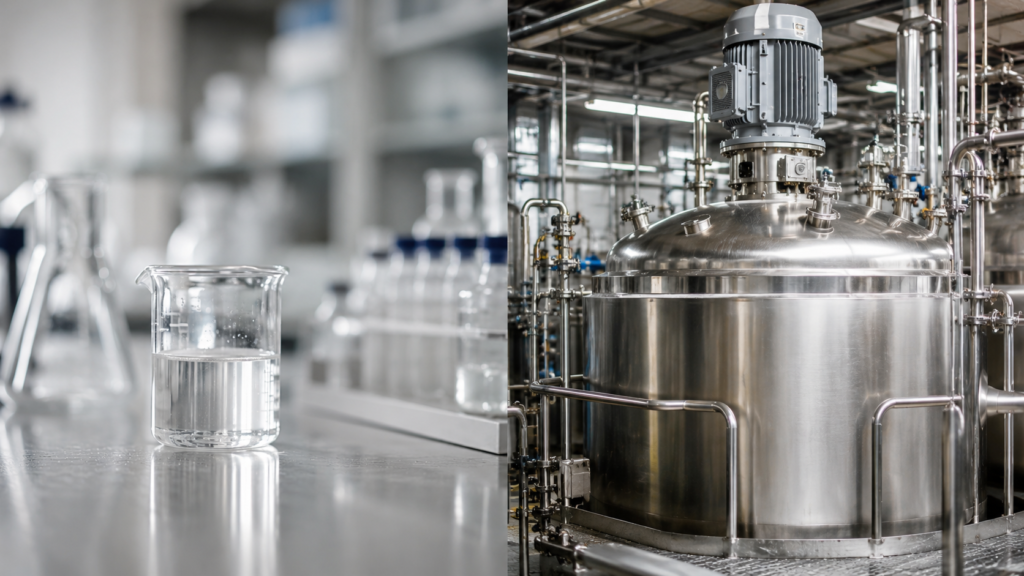
Lab Bench 200–500g batch
scale-up
Production Tank 1,000–2,000L batch
Same formula, very different mixing shear, heat transfer rate, and hold times.
Four Things That Almost Always Change Between Bench and Production Scale
- Mixing shear — lab mixers and production equipment (homogenizers, in-line mixers, large batch tanks) apply very different shear profiles, which affects emulsion droplet size, viscosity, and stability
- Heat transfer rate — a small batch heats and cools far faster than a large tank; ingredients sensitive to how long they spend at a given temperature (not just peak temperature) can behave differently at scale
- Mixing/hold times — what takes 5 minutes to fully incorporate at bench scale might take 30+ minutes in a production vessel, changing exposure time for heat- or shear-sensitive ingredients
- Ingredient sourcing — lab-grade or small-lot ingredients used during development aren’t always available (or identical) at production volumes; supplier substitutions at scale can subtly shift performance
The Takeaway
Good scale-up planning treats production equipment and process as part of the formula, not an afterthought once the “chemistry” is done. Building process parameters and equipment considerations into development from Stage 2 onward — not just at the final handoff — is what separates formulas that transition cleanly to manufacturing from the ones that need a costly redevelopment cycle once they hit the plant floor.
Planning a product launch and want a formula built for your actual production equipment from day one? Start a custom formula brief — we’ll have a development plan back to you within 48 hours.
